Oh, Baby…. this is gonna be a long one. The reasons we left Ecuador are extensive. But here goes.
Doing Our Research
Before we moved to Ecuador in March of 2023, we followed all the online advice. We read the blogs. We watched YouTube videos. We paid heed to the “cons” of all the pros and cons of living in Ecuador blogs.
We even took a six week exploratory trip six months prior to our move. We felt as ready as we could be.

But you really have to spend more time in a culture to fully experience it. For Jeremy and me, reality starts to hit home around the six to nine month mark. For others, it may be more time, or less. But there comes a time when the honeymoon’s over and you begin to see your surroundings for exactly what they are.
That’s the time–in my humble opinion–to commit to whether or not you want to become permanent residents of a country.
Things We Didn’t Take Into Consideration Prior To The Move
We started out our Ecuadorian adventure in the small town of Cotacachi. High in the Andes, the community of mostly indigenous people exudes charm and warmth. We found a house to rent that we loved, and Jeremy bought a bike and happily settled into riding several mountain routes that taxed his endurance as it freed up his mind.

We learned to speak–if not totally understand–Spanish at a level that allowed us to conduct our daily business in town. I actually got to the point where I could have conversations with shopkeepers and at times joke around with them, which delighted me, and enticed me to delve even further into my Spanish language lessons.
Here’s what we didn’t expect
Cotacachi is home to a relatively small group of expats. Exact numbers are unclear, but seem to range between 400-500. Enough for us to establish a social circle, we thought.
I say this with all due respect to the American retirees in Cotacachi: we are simply not in the same place as the vast majority of them. So, while we had wonderful neighbors and a few friends in the village, there was really only one or two people that I felt connected to on a deeper level.
American Expats in Cotacachi
The sense we got from many American expats in Cotacachi was that they had worked hard all their lives–often at jobs that they at best tolerated, and at worst, despised. Moving to Ecuador was, for many, a dream come true, where they could retire at a younger age, live affordably and just relax: soaking up the sun and the cheap avocados.
Justifiably, many of these folks were content–after so many years of working at less than desirable occupations–to sit around and vege out. But Jeremy and I have limited tolerance for vegging out activities. While we’re content to spend the occasional Sunday lounging about, by and large, we’re happiest when we’re doing something productive for others or ourselves. A bocce ball and bingo life isn’t what we’re striving for.

On the surface, it all seemed idyllic. We threw dinner parties, I met new friends for tea dates. But so little of it felt meaningful to me. It started feeling like we were just going through the motions. We weren’t interested in hanging out at the local expat haunts. We’re not big drinkers, so sitting around knocking back a few brews gossipping or talking about our physical ailments didn’t do it for us. And–while we occasionally enjoy a meal out–we prefer to cook at home for health reasons, so the persistent invitations of “let’s meet for lunch” was something we only indulged in periodically.
We also still work, albeit part-time, on our wedding business, and self employment is still a passion for me. I didn’t have anyone to share that with in Cotacachi. Other expats couldn’t fathom why we continued to work. I had one friend who flat out asked me, with the deepest of concern, “You seem to be doing okay financially–why on earth do you keep working?” The expats in Ecuador just couldn’t seem to grasp that there are other reasons to work besides financial ones. I guess if you spend much of your working life doing something that you can’t wait to retire from, that’s your outlook. But that’s not my experience.
All in all, with a couple exceptions, I just didn’t feel like I had anything in common with the expats there. I looked into volunteering, an activity which kept one of my neighbors thriving, but Cotacachi is so small that it has limited opportunities for volunteering. And none of the charities there–although certainly great causes–really spoke to me.

The Lesson Learned?
It’s not just about adapting to the culture of your adopted country. You also have to make sure you’ll blend in well with the other expats there. Most times I felt like a fish out of water. And don’t get me wrong: I’m not casting aspersions on any retiree that is happy to kick back, relax and do a whole lot of nothin’ during their golden years. In fact, I envy them. It’s just not what I need to be content. (I never said I was low maintenance.. 😀)
And then what happened?
Still thinking that Ecuador overall was for us, we decided to move ourselves from small town Cotacachi to the big city. I found a house I was sure we were going to love, in a gated community in Cumbaya, a bedroom community of Quito. More to do. More to see. A more sophisticated city vibe. Oh yeah, this’ll be it.
It wasn’t it.
This is where things got really “interesting.”
Dangerous and Discourteous Drivers
Living in the city is where the true surreal experience began. The first time I felt aware of the stress was on a walk home from the local shopping center. Most business and retail parking in Cumbaya is pull-in, nose first parking for cars. That means that pedestrians on the sidewalk (if there is one) are constantly having to walk behind parked cars. That’s no problem, as long as the cars remain parked. But inevitably, one of the cars in the row would have a driver in it–a driver that would throw the vehicle into reverse and back into the street without even a cursory backward glance.
I wasn’t conscious of it at first, but gradually on that walk, I began to notice how stressful it was just walking about town. It was nothing like my walks in the States where my thoughts roamed freely. I’ll tell you, I’ve solved many a weighty issue by pondering them on my meandering walks. In diminutive Cotacachi, the walking routes weren’t all that varied–but at least I never felt like I had to be on constant guard so as to not be flattened like a pancake.

I began to notice all the other discourtesies of drivers. Cars turning into streets at intersections as I was crossing and nearly mowing me down. I can’t tell you how many near misses I had. Or drivers parallel parking on the street as I was walking toward them, only to have the occupants throw open the door into my path on the sidewalk at the last minute. Those types of things weren’t as life threatening, but they were damned annoying. And I greatly missed the ability to roam and let my mind wander. All my mental energy was going toward remaining upright and intact.
Even something as simple as crossing past a driveway could be death-defying. So many times, I’d be walking across an unoccupied strip of asphalt leading to someone’s house, or an entire complex, only to have a car turn directly into my path from the street as I passed.
You have to Embrace the Culture, They Said
Everyone gives you the same piece of advice when you move to a new country. “You need to respect the culture and norms of your new home.” And of course, that makes total sense. You can’t be the Ugly American (well, you can, but you shouldn’t) who barges in and insists on doing everything the way it is done in the States. Make the effort. Learn the routines, Practice speaking the language. Don’t expect everything to be done the way it’s done in the US. That’s the conventional wisdom.
This wasn’t our first expat rodeo. We lived in Mexico for a couple of years, so we knew the drill. Latin American cultures are noisier than Americans are used to; they don’t place a value on efficiency the way Americans do. They revere family above almost everything else. They are not as openly friendly to strangers as we are in the US. Most importantly, they are seldom in a rush the way Americans are; standards of time keeping are…. well…. much more “fluid” than in the US.
So none of that was a surprise–nor was any of it a deal-breaker for us. But there’s a deeper layer to these cultural values that doesn’t often get talked about.

When Values Clash
When I first moved to Ecuador, I struck up a conversation with a 30-something American expat who’d been living in Quito for five years. At one point, we were talking about her future plans, and she indicated she wouldn’t consider having children while still living in Ecuador. I asked her why–thinking it might have something to do with the educational system. Her answer had nothing to do with that. She said that she didn’t feel children in Ecuador were brought up with the same moral standards with which we raise children in the US. When I pressed her, she finally blurted out, “Most Ecuadorians will lie through their teeth to get what they want. For them, the end always justifies the means.”
I remember thinking at the time, “Huh! That’s not been my experience.” (At least, that I knew of.) But remember that I was living in small-town Cotacachi, which is primarily indigenous people. I may have it totally wrong, but these seem to be salt of the earth folks that would give you the shirt off their backs if you needed it. (Not that it would fit our larger American bodies, but it’s a metaphor! 🥹) I filed the info away under my mental folder titled “Other Peoples’ Perceptions” and went on with my expat life.
But the unease was growing
I’m not sure if that conversation planted a seed in my subconscious or not. I certainly wasn’t aware that I was actively seeking to prove or disprove the question of the moral code of Ecuadorians versus Americans. But my perceptions were beginning to shift. Morals or not, I was becoming keenly aware of just how exhausting it was to be living in Cumbaya.
So Many Lies!
The first time I started to question the veracity of the Ecuadorians with whom I came in contact was when we set about renting the house in Cumbaya. We were told lie after lie about the house we were renting and the community in which it was located. From the amount of the rent (which mysteriously increased when it came time to sign the lease), to being told that the community had guards onsite 24/7, when in actuality, there was only one guard who was there six days a week from 8:00 AM to 6:00 PM. The rest of the time, the development was at the mercy of the alarmed gate and everyone in the development had an alarm controller, so the security was loosey goosey at best. More on that later.
Even that didn’t raise huge red flags. We simply assumed an error had been made on the part of the rental agent, rather than immediately thinking he’d flat out lied. (Spoiler alert: he did.)

It’s like that first set of lies started the snowball that mushroomed into an avalanche of fabrications. This post would go on for days if I listed every one in detail. Every vendor with whom we dealt ended up giving us false information. Everything from how long the work would take, when things would be delivered, who would do the work and what was included, how much it would cost… you name it, we were told falsities. It was a full time job keeping on top of these guys to make sure they didn’t rob us blind.
One of the things about Ecuadorians is that they seldom volunteer any information. You have to know enough to ask the right questions–then you may or may not get a truthful answer. For two Americans relatively new to the country, we simply didn’t know what we didn’t know. And that combination is the kiss of death. We were chronically doomed for disappointment because we didn’t know enough to ask the right questions beforehand.
Money Changes Everything
The other thing I was discovering was that when it came to money, all bets were off. The assumption is that, as Americans, we’re loaded. And compared to the average Ecuadorian, we were. But that didn’t mean we were okay with being cheated. I once witnessed a heated conversation between an American and an Ecuadorian. (Thankfully, I was not a participant in the conversation.) The American was sick and tired of being “gringoed” (i.e. charged more because of his nationality and the color of his skin) whereas the Ecuadorian argued that Americans should pay more for products and services in Ecuador simply because their income could support it, and, after all, “that’s still less than you’d pay for the same things if you were in the US.” 🤷🏻♀️

When it came to coming up with cold, hard cash, all bets are off in Ecuador–especially if you’re American. The perception is that you have it, so you’d better pony up. I’ve seen landlords try to pin the most outrageous things on their Gringo tenants to avoid paying for repairs. One house was infested with bugs. The landlord said the Gringo tenant brought them in with her. Another had a backed up sink and said it was due to a spoon dropped down the sink by the Gringo tenant. Yet, the spoon mysteriously disappeared when the tenant asked for evidence. I witnessed bathrooms installed in houses with zero ventilation and then the tenants asked to pay for the cost of mold removal.
How do you embrace the culture of your new country when their values are contrary to your own?
This was the battle that was waging in my head before I even knew I’d declared the war. I have based my life–and Jeremy and I our relationship–on a foundation of honesty. It’s undoubtedly my #1 value when I interact with the world. Yet here I was, surrounded by people for whom that value was quite low on the totem pole.
This lack of ethics permeates all levels of society in Ecuador. There’s corruption in the highest levels of government, in the judiciary, the prisons, the police force, and it trickles all the way down to the average Jose on the street.
What the actual f*&^ were we supposed to do now????
But Wait! There’s More!
Besides the constant need to watch our backs in everything from walking down the street to renting a home, the growing security issue in the country was beginning to weigh on is.
For those who don’t know, Ecuador was once considered the safest country in Latin and South America. However, that has changed over the last decade, as Colombian drug cartels have infiltrated the country. Granted, that crime associated with the cartels is mostly on the coast, and we were located high in the Sierras, in the capital city of Quito. But it is gradually seeping into the city as well. Plus, Ecuador is a poor country, and people have to eat. And the average $450 monthly salary of most Ecuadorians just doesn’t cut it. That leads to lots of “crimes of opportunity.”
And with the perceived wealth of American expats, Jeremy and I felt like we had targets on our back. For one thing, at 6’3″ and 5’10” tall respectively, Jeremy and I couldn’t look any less Ecuadorian. And our light complexions didn’t help. Yes, we spoke enough Spanish to get by, but “blending in” was not exactly realistic.
Jeremy was accosted twice by the infamous Ecuadorian bird poop scam. The first time, the thieves got away with the entire contents of his backpack–including his new cell phone. The second time, after unsuccessfully trying to distance himself from the thieves, he took out his pepper spray and threatened them, and they immediately ran off–empty handed.
There were news reports of armed robbers targeting entire restaurants full of patrons by swooping in with knives and guns to steal money, jewelry and cell phones. All of these incidents were caught on security cameras, but nothing was ever done. The police in Ecuador are not well paid, and that results in a fair bit of “not my circus, not my monkeys” where pursuing criminals is concerned. Most people don’t even bother to file police reports when they are victims of crime. It simply isn’t worth the effort.
More worrisome were stories of kidnappings and home invasions of both wealthy Ecuadorians and expats. And as an aside, almost all of those YouTubers that we followed to get advice about living in Ecuador? They’ve all left for greener (and safer) pastures.

Lack of Security in Our Own Backyard
Which brings us back to the (lack of) security issue in our residential development. When the guard wasn’t there, the idea that we had security was a joke. Yes, our small community of seven houses was surrounded with an alarmed fence. But everyone in the conjunto had a controller to disarm the alarm. Every adult, every teenager, and apparently, every friend of said teenagers, the school bus driver… you name it. Everyone had access to our community.
The president of the HOA was continually sending group messages admonishing people to engage the alarm when they left the premises. I don’t think anyone ever did. The alarm was off more than it was on.
And when the alarm went off, it was inevitably a false one because–more often than not–our neighbors never seemed to grasp the concept of how and when to turn off the alarm when they left after hours or on weekends. The damn thing went off at least three times a week, and no one ever paid any attention to it. The bad guys could have come and robbed us blind and the neighbors would all shrug it off as a false alarm.
With each passing day, we felt less safe.
Everything Else
Then there was everything else–not the things that were necessarily deal-breakers in and of themselves, but that made life difficult (over and above the lying and the crime).
Power Outages
As of this writing, and for the entire time we were in Ecuador, all of South America is going through a severe drought. Since all of the power in Ecuado is hyroelectric, the shortage of water, combined with the outdated (and mostly ignored) infrastructure of the electric plants, meant there were constant power outages. We bought a battery backup to run our modem and computers, but it was still a major pain to work around the outages when they went on for months.
Lack of Concern for the Environment
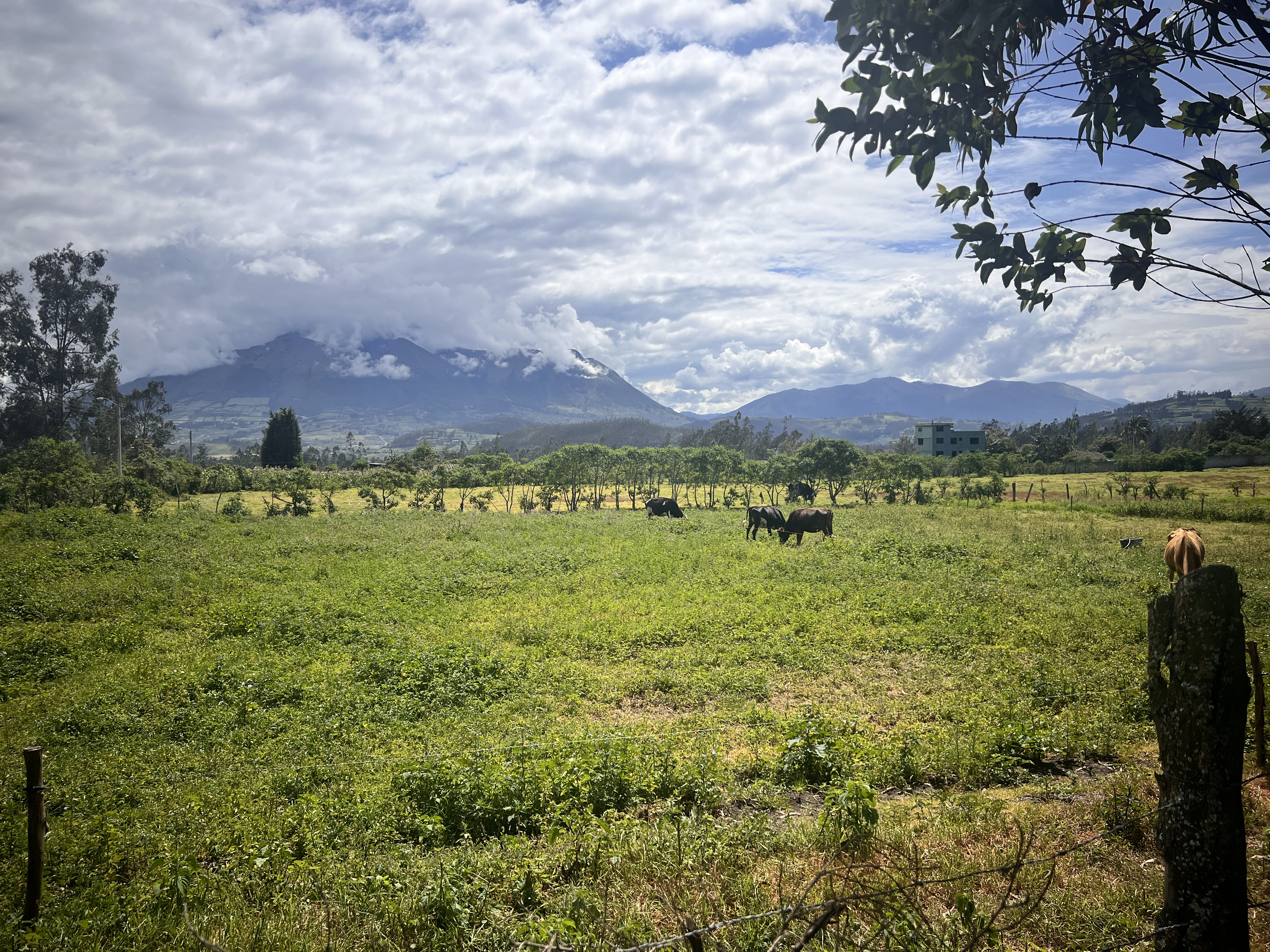
Make no mistake about it, Ecuador is a beautiful country, and the Andes mountains are downright breathtaking. But the beauty is often marred due to people’s lack of respect for Mother Nature. Garbage lines many of the mountain hiking trails, and the creeks often emit the stench of the sewage that is dumped into them. It’s disheartening to see such beauty and have to cover your nose because the smell is unbearable.

Noise
As previously stated, we knew Ecuadorian culture would be noisier than what we were used to in America. We totally lucked out in our first house in Cotacachi, which was in a quiet and serene gated community. The only thing we ever heard was people partying on Friday and Saturday nights until the wee hours of the morning. It was far off enough where some white noise and earplus made it possible for us to sleep. And… ya know… when it Ecuador…
Cumbaya was a different story. I thought we’d screened the neighborhood sufficiently, and were told it was “muy tranquilo.” (More lies.) Cumbaya is an affluent community with highly educated inhabitants. We (wrongfully) assumed that meant more considerate neighbors. Wrong again. Additionally, the HOA had regulations in place to prohibit any noise that disturbed one’s neighbors. We thought we’d be fine.
The best laid plans…
In addition to the constant alarms going off, there were dogs left out on rooftop decks left to bark 12 hours a day until their owners returned home. The kid next door took weekly electric guitar lessons, with the windows thrown wide open. Let’s just say, I hope the guy doesn’t give up his day job because his “playing” was nothing short of an assault on the ears. He was god-awful. Loud, but god-awful.
But the most crazy-making incidents occurred when one or another of the neighbors decided to throw a party. And Ecuadorians love to party. When Guitar Kid graduated college, Mom hired a mariachi band to come play outside the house (right next to our windows) for an hour. I thought my cats were gonna have kittens–and they’re males!!!
Another rooftop party went on well past 1:00 AM with amplified music. By then, I’d had enough and messaged my landlord asking what could be done. I was told to “take it up in the communal WhatsApp group.” Now, I’m no mediative genius, but I knew bringing up a problem with one neighbor in front of the entire group was going to be a bad idea. But that was the outlet I was given.
Let’s just say, it didn’t go well. Basically, I was told the HOA rules were “merely a suggestion,” and that I needed to chill the hell out.
I think it was around that time that Jeremy and I starting plotting our escape. We’d just had it. The cats where chronically jumpy. As was I. That house had a weird vibe to it that was unsettling.
Then we had a middle-of-the-night earthquake, which rattled me to the core (both literally and figuratively) even though my California-raised husband shrugged it off. I had vivid flashbacks for weeks.
The Inability to Drive
I knew I was going to miss driving when we decided to go car-free in Ecuador. Functionally speaking, we didn’t need a car. We were always able to walk, Uber, taxi, or take the subway or bus to wherever we needed to go to meet our daily needs.
But I hadn’t figured that we’d never be able to drive down here. Renting a car for drives outside of the city was always the plan. Until we found out what happens when there is a car accident in Ecuador. Bottom line is that–unless there is a clear person at fault–everyone goes to jail until things can get sorted out. And if there is a group of people involved in the accident and one of them is a Gringo, you can bet that every Ecuadorian involved is going to band together and point fingers at the “wealthy” Americans as being the cause of the accident.
I’m way too pretty to languish in an Ecuadorian jail overnight. 😁 And I felt resentful that one of the true pleasures of my life had been taken away from me. Some folks are more than happy to give up the stress of driving. I wasn’t one of them.
Putting It All Together
When you’re living in a foreign country, it’s easy to get caught up in the day to day activities that require more effort and concentration that they did when you were back in the States. But there comes a time–if you can find a moment to just get quiet and THINK–when you reflect on your life. In our case, it didn’t take us long to to realize how stressful all of the above made it for us to live in Ecuador. Some of the issues may have been able to be remediated, or tolerated. But only partially so.
The reality is that living in Ecuador for us became a daily struggle of having to be constantly on guard. And one of the reasons we went there in the first place was to relax. And in a twist of fate so in-our-faces that we could only laugh, they started a demolition on houses behind us a scant two weeks before we left. Our house shook like crazy for several days.
We get it Universe, you want us out!

And some of the issues–such as systemic crime, as well as incompatible moral codes–would never resolve themselves to our satisfaction. They’re simply built into the cuture. Here’s another firsthand experience from an expat that left Ecuador.
So, to the folks that say, “if you don’t like it, then leave.” We’ve left. We’ve got more adventures in store, but that’s a story for another day.






Leave a Reply